
Word Count 108: Conferences, Fieldwork, great radio comedy
Plus I seem to have written an awful lot about reading.


Hi there,
I’m really not sure how, but I seem to have gotten my weeks mixed up, so last week’s newsletter is coming to you today!
Suw’s news: OKRE Summit and proofreading
Thanks to a friend of mine, I’m dusting off my proofreading skills and carrying out the final pass on a novella. I learnt to proofread professionally right at the beginning of my career and amazingly have remembered almost all the BSI marks, largely because I still use them when I proof anything. So, if you have any proofing you want done, hit me up. I have an alarming amount of room in my schedule.
A couple of weeks ago, I went to the OKRE Summit 2025, a conference bringing together the TV industry, the third sector and creatives to hear about…
…how entertainment fuelled by collaboration creates more authentic, impactful worlds on screen. It will have a particular spotlight on stories developed in collaboration with lived experience or academic research.
My ears perked up at the mention of academic research, but the focus was more on social justice and inclusion than introducing basic scientific research to the general public. That said, I had a great day and met some lovely people. I even met a couple of people who knew about Ada Lovelace Day, which was a pleasant surprise.
Next week, I’m off to the Communicate conference, “ the UK’s leading annual conference for environmental communicators”, which will be perhaps a bit more up my street.
Fieldwork: Our precious island of biodiversity in the city

A couple of months ago, I was delighted to write a piece about the importance of small green spaces like Brompton Cemetery for biodiversity for the Friends of Brompton Cemetery Magazine. It was a real joy to do the research and write the article, and it makes me pine for the days when it was at least vaguely possible to make a living from doing such things. Alas and alack, word rates have not gone up since I was working as a music journalist in the late 90s (in some cases, they’ve actually gone down).
Please pop over to the Fieldwork site and take a look, and hopefully you’ll enjoy reading it as much as I enjoyed writing it.
Stop, look, listen: Welcome to Our Village, Please Invade Carefully
BBC Radio 4 have finally repeated Welcome to Our Village, Please Invade Carefully, Eddie Robson’s audio comedy about the alien invasion of a small English village. The pilot is only available today, so listen now if you have 30 minutes spare.
I’ve been trying to listen to more audio comedies, but as with TV, I have been finding it hard to gel with a lot of what’s available. But Eddie’s script is great, with proper belly laugh moments – it’s well worth your time. Though do not shilly-shally, lest it vanish into the depths of the BBC’s archives, not to be seen for another 13 years.
Read this: A bit of good news about reading?
The publishing industry seems to be in a permanent tizz about the state of reading, with much handwringing about how no one reads (ie, buys) books any more and we’re all doomed, doomed I tell you.
So it is lovely to hear a bit of hope in this interview with Booker Prize winner David Szalay:
There seem to be some grounds for optimism about that and it seems that younger people, by which I mean people under 30 or so, are reading. I did this event in New York a couple of months ago with [pop star and book podcaster] Dua Lipa, and she has a book club and she’s very passionate about reading and books, and obviously has a very large number of people in her book club and social media followers and so on. I mean, she’s 30 and probably most of the people who follow her are about the same age or younger.
And so I think there is a sense that reading has become something which is recognised by younger people as beautiful and rewarding and fulfilling, and something which is just unique. And so, yeah, I’m not too pessimistic about that either.
I’d not really heard of Dua Lipa (I know, I know) until the OKRE Summit, where the opening talk was about her rise to fame on YouTube, including a bit about her book club. It’s fascinating that all the famous authors and TV personalities with book clubs – Oprah, Richard and Judy, Reese Witherspoon, just for starters – seem to have done a great promo job for featured authors, but don’t seem to have had much of an impact on how reading itself is perceived.
Like many industries, publishing has turned into a barbell market where you’re either wildly successful at one end, or very not successful at the other, but there’s not much mid-market activity where an author can make a reasonable living by publishing a moderately successful book every year or two.
Celebrity book clubs tend to push readers towards the wildly successful authors, or perhaps even create those wildly successful authors, skewing the market and making it harder for those who go unblessed. However, if Dua Lipa is truly making the act of reading cool again, we should see upticks across all publishing sectors. I guess we’ll have to wait and see.
Read this, two: What if publishing’s problems are down to poor reading skills?
I remember reading a while back about how bad the American school system is at teaching reading, then stumbled on this piece from 2019 which I found absolutely shocking. The TL;DR is that US schools continue to teach reading via the ‘three-cuing’ system, “a theory about reading that cognitive scientists have repeatedly debunked”, and which is based on techniques poor readers use to muddle through when they find reading hard.
This teaching methodology has done and is doing serious harm to American children’s and adults’ ability to read, and raises some significant questions in my mind about whether it is contributing to the current, er, situation over there. If you can’t read well, you can’t tackle complex texts and you can’t develop your critical thinking skills or your ability to read multiple sources and then synthesise your own opinions out of what you’ve read.
There have been a few essays recently about how we’re entering a ‘post-literacy’ era, laying the blame on smartphones, TikTok, Instagram, etc., but poor teaching predates all of these things. Perhaps, instead, people are turning to TikTok and Insta precisely because reading and writing is too taxing for them. Given how much reading and writing I do in full, grammatically correct sentences on my phone, I find it hard to believe that the device itself is the problem rather than a symptom.
So this terrible, damaging and outdated pedagogy is what Dua Lipa is battling. Let’s hope she’s up for it.
Read this, three: Maybe the UK reading crisis is an identity crisis?
It’s funny how sometimes a theme appears without me looking for it, and this time it’s definitely reading.
The Reading Agency’s State of the Nation’s Adult Reading: 2025 Report is out now, but the headline stats seem to suggest that maybe young Brits at least really are enjoying reading more:
53% of UK adults now describe themselves as regular readers – up from 50% last year. The sharpest rise is among 25–34-year-olds, where engagement has jumped from 42% to 55% in just twelve months.
Dua? Dua? Is that you?
However, we do have an identity crisis:
Yet 47% of adults reject the label of ‘reader,’ even though most of them are reading daily. The research shows that 77% of these so-called “non-readers” regularly consume text in other forms, including news articles, recipes, game narratives, or graphic novels.
Is there perhaps an idea that ‘readers’ are ‘swots’, the kids that got bullied at school for having their nose in a book all the time? Certainly, at a societal level we do demonise reading. Consider the comparison between being ‘street smart’, which is coded as good, and ‘book smart’ which is a weaselly way of saying ‘stupid’. There is both a snobbery and a reverse snobbery around reading, so it makes sense that some people reject the label.
Plus, unsurprisingly, the less skilled people are at reading, the less they read. Teaching reading well, ensuring that children leave the school system fully literate, is essential if we’re to have a society that reads, understands what they are reading and can follow complex arguments in text.
There are lots more interesting stats in the summary and the full report.
Four: HarperCollins wobbles
Great piece on how when the enormous ship that is HarperCollins takes on water, the rest of the industry reaches for the lifebelts. The publishing giant lost $13m last quarter due to the closure of a US book distributor; orders from Amazon were down; audiobook sales dropped 11 percent and ebooks by 9 percent.
And HarperCollins’ problems have knock-on effects on every part of the industry. But the news isn’t all bad:
There is a silver lining. These moments of instability tend to expose who is adaptable and who is not. Independent presses —the ones you might be eyeing for your next project —often thrive in these windows because they are faster, leaner, and more personal. Readers also tend to swing back toward authenticity, toward the kinds of books that feel intimate and human, not mass-produced.
So if you are in the middle of writing something that feels too weird, too niche, or too emotional, keep going. The market may be shaky, but the appetite for real storytelling never is.
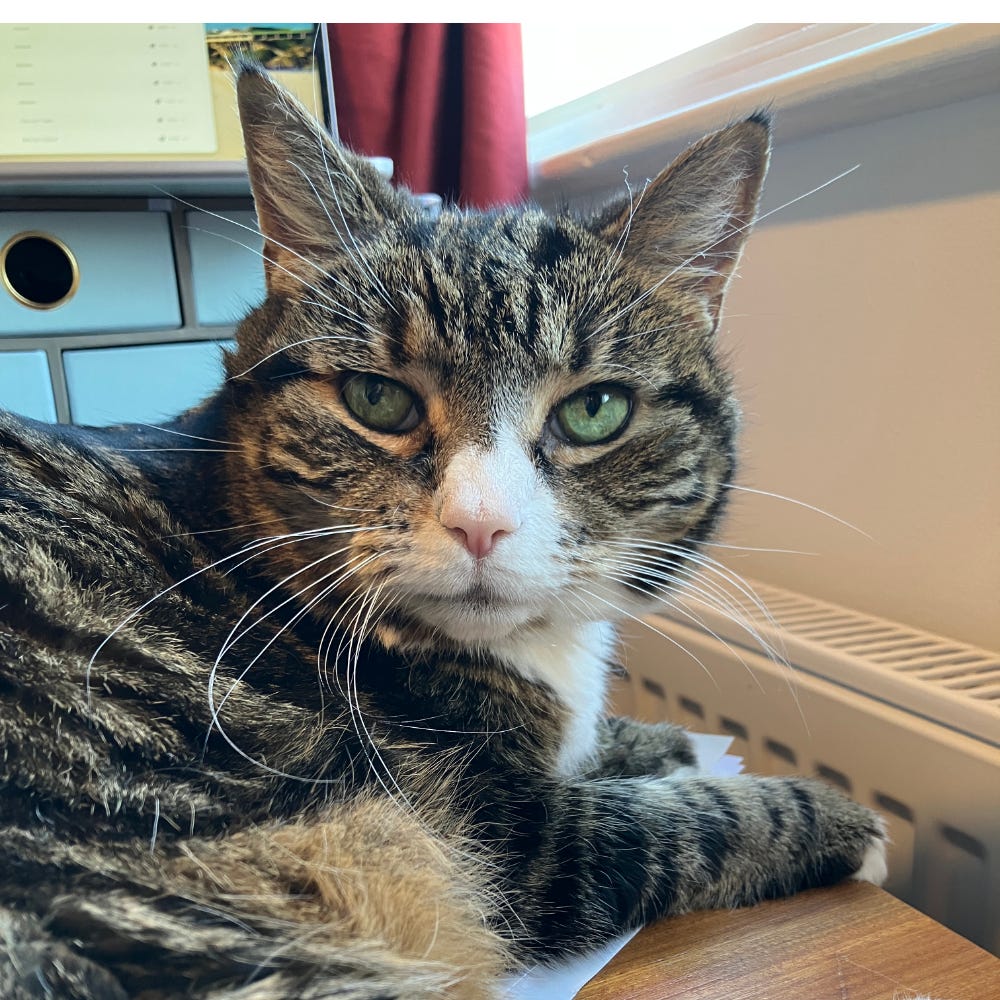
Obligatory cat picture
Grabbity has taken to sleeping on my desk for long periods at a time, which is marvellous.
Right, that’s it for now! See you again, er, perhaps next week!
All the best,
Suw