
Word Count 114: Basic Income just works
Unfortunately, so does churning out 200 AI-generated books per year, it seems


Hello there,
Some weeks, I have more links than I can share and other weeks the creative industries seem to go into torpor. Or maybe it’s me going into torpor – I certainly would have liked to have slept through all the rain we’ve had recently.
Basic Income just works
Ireland has just announced that it will be providing a basic income of “€325 (£283) a week” to about 2,000 artists after its 2022 pilot project turned out to be a success. The BBC reports that “every €1 (£0.87) invested in the pilot had generated €1.39 (£1.21) in return while allowing artists to devote more time to their work and improving their quality of life.”
Applicants will chosen via an “anonymous randomised selection process”, which will hopefully be a lot less painful than most grant application processes.
Scotland is now also looking at a “basic income for the arts”, taking its lead from Ireland.
In Scotland, culture funding has tended to be focussed on arts organisations.
But the wider approach is under review by the Scottish government.
This follows an independent report focussed on funding body Creative Scotland that found criticism in the sector of the ‘trickle-down’ funding model, from government to organisations to individual artists.
In Wales, musician Simon Lewis has launched a petition calling on the Senedd to explore the feasibility of setting up a basic income scheme modelled on the Irish program. Nation.Cymru reports that:
According to the Musicians’ Union Wales, funding cuts from arts councils have led to a reduction of around £3 million in annual funding, representing a 50% fall in the real terms value of public subsidy since 2025.
And as Lewis says in the petition:
This initiative would build upon Wales’s successful Basic Income Pilot for Care Leavers (2022–2024) and align with the Well-being of Future Generations (Wales) Act 2015, which commits the government to sustainable cultural and economic wellbeing.
Supporting artists is not charity — it’s infrastructure.
A secure creative class drives innovation, tourism, wellbeing, and national identity.
In England, it seems that the calls for a basic income are a bit more fragmented, with the usual suspects in favour, and the other usual suspects against.
But politicians’ inability to get behind either a basic income for artists or, preferably, a universal basic income (UBI) is at odds with the evidence.
American Scott Santens has been a vocal advocate for UBI since 2013 and has collected a large library of evidence of various trials around the world which find, overwhelmingly, that basic income works. It lifts people out of poverty, allows them to access housing, reduces substance abuse, and puts money back into the local economy.
We are rapidly moving towards a world where UBI will become unavoidable. Creatives are merely the obvious candidates for cautious politicians — a relatively easily defined group of people who are already understood to earn naff all, but who are generally seen as contributing to culture and society.
And I do know so many people in the creative industries who are, by all obvious measures, successful. They’ve had TV shows made, received awards, sometimes have huge social media followings, and yet they are still struggling to make the maths math because they are no longer getting residuals or royalties, no longer getting the work they used to, and are paid at the rate that’s in some cases lower now than it was 20 years ago. Worse, secondary income streams like editing or teaching are harder and harder to secure.
We are four years into a ‘cost of living’ crisis that was never that at all. It was always a low wages crisis, with wages stagnant in the UK for the last 15 years, at least. The majority of us are not earning enough and the jobs market is brutal right now, particularly for young people and middle-aged people. The idea that we can all ‘just get a job’ is for the birds.
Piloting basic income for creatives is a good first step, but as a society and as an economy, we need everyone to have access to a proper UBI. And we need that before the jobs market is completely destroyed by AI.
Many of us have been trying for years to find ways to create our own ‘basic income’, that steady trickle of money that keeps us financially ticking over. Four years ago, I hoped Substack would be that for me, but after a flutter of excitement when they launched Notes, it became clear that it was just impossible. You need a huge audience on Substack to have any sort of substantial income, and I was not and am not writing the kind of content that will ever build me a big enough audience, nor was I willing to change what I was writing, and nor did I have a huge audience to import from elsewhere.
I knew Ada Lovelace Day, which was my full time job for ten years, was going to one day close, but had no idea that the year it did would also be the worst year for business and employment for decades. So I’m still trying to create my own basic income, seeings as the government seems allergic to actually solving people’s everyday problems, though this time it’s through helping people practice their Welsh so that they can progress towards fluency.
Honestly, right now, that seems like the only thing one can do. But this is resiliency, right? You get knocked down, but you get up again, and you try to find a different way to earn enough money to keep the wolf from the door.
Meanwhile…
The factory farming model of novel production
The New York Times reports on how some romance writers are adopting AI in order to write more books, more quickly. Writer Coral Hart, for example, “created 21 different pen names and published dozens of novels”:
with the help of A.I., Ms. Hart can publish books at an astonishing rate. Last year, she produced more than 200 romance novels in a range of subgenres, from dark mafia romances to sweet teen stories, and self-published them on Amazon. None were huge blockbusters, but collectively, they sold around 50,000 copies, earning Ms. Hart six figures.
I can’t help seeing Hart’s use of AI has a symptom of a broader financial and cultural dysfunction. We live in a world where writing one novel a year, which would be incredibly productive for some authors, can no longer provide a liveable income for most people. Even very prolific writers working without AI usually struggle to (self) publish enough to keep the lights on, given that any individual title won’t likely sell in big numbers.
So now we’re solidly into the era of factory farming novels. That trend isn’t new — a few years ago people were touting the practice of hiring cheap writers and editors on Fiverr and producing 20+ novellas a year. But now, those people are using AI to produce ten times that, and then passing the grift on by offering training so that you can do the same.
Would these same people be doing this if, as a writer, they could make a decent living doing one human-made book a year? Or is it just that these are people that don’t enjoy writing at all, they have just found what they consider to be an easy way to make money?
The dysfunction here is twofold:
Writing does not pay. No matter how passionate you are or how good you are, it’s highly unlikely that you’ll cover your bills.
We still laud writers even whilst we expect them to work for peanuts. Writing a book still has cachet, but, well, see point 1.
So the social reward for writing a book is still huge, whilst the financial rewards dwindle. Those who are looking for the latter use AI to play a numbers game, and they get to claim the former despite having not actually written the books themselves.
They don’t have to develop a big following for any single pen name because the sheer volume of titles is what makes the money, not their audience. Indeed, their audience is largely irrelevant. Who cares if a book, or even twenty books by one pen name crash and burn when you have another 19 pen names out there with another 180 books to game the system with. Fans are meaningless, the only thing that counts is volume.
Meanwhile, passionate people who labour over their books can’t afford to spend as much time as they’d like on them, have to do more free labour around promotion for publishers who shirk their responsibilities, but increasingly can’t build enough of a following to find financial success.
Indeed, the more people flood the market with AI slop, the harder it will be for hand-crafted books to find their audience, the more we will need some form of UBI to keep our various creative crafts alive.
Obligatory cat picture
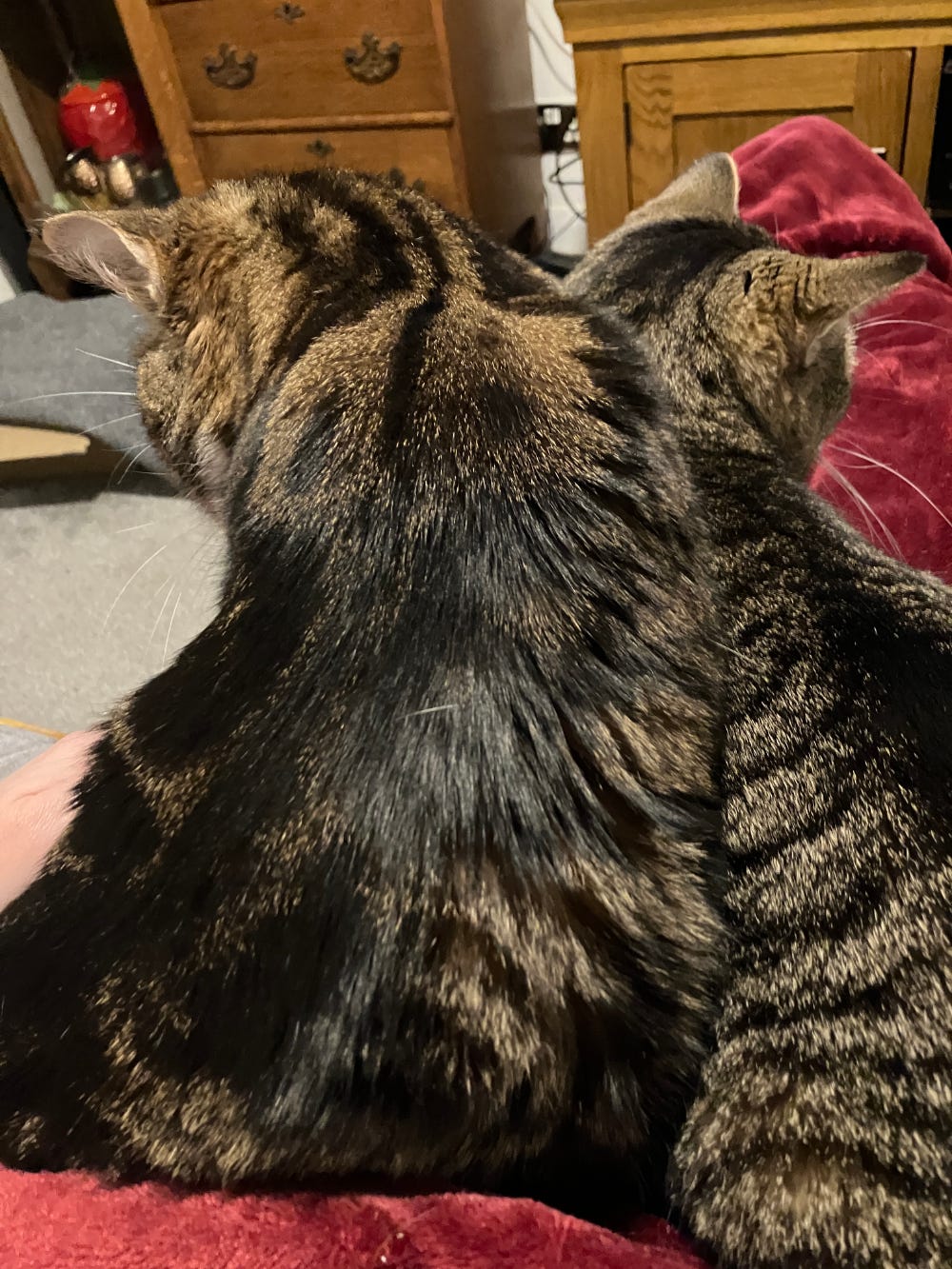
Grabbity and Copurrnicus both wanted to sit on my lap at the same time, and for a brief moment, they did. But the peace did not last.
Right, that’s it for now!
Ttfn,
Suw
I've seen it said the profit here is selling the course. and using Amazon Unlimited to get pennies per book. Hart's books have few reviews.